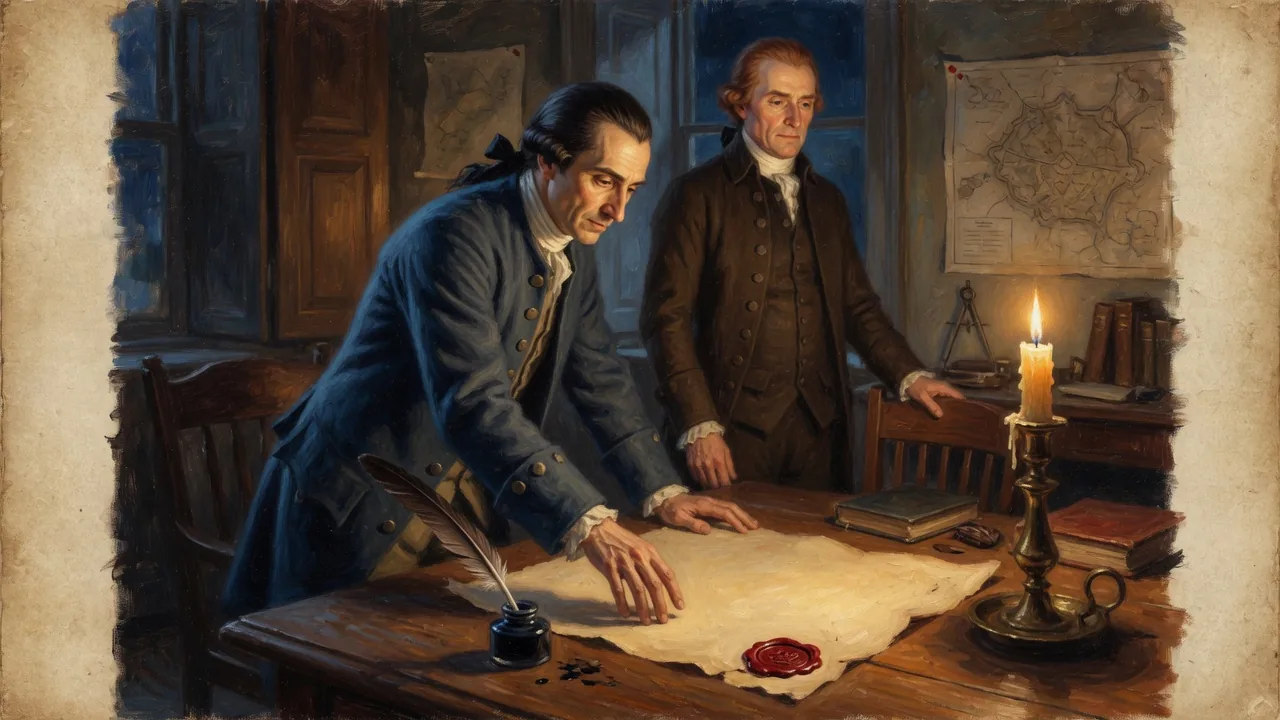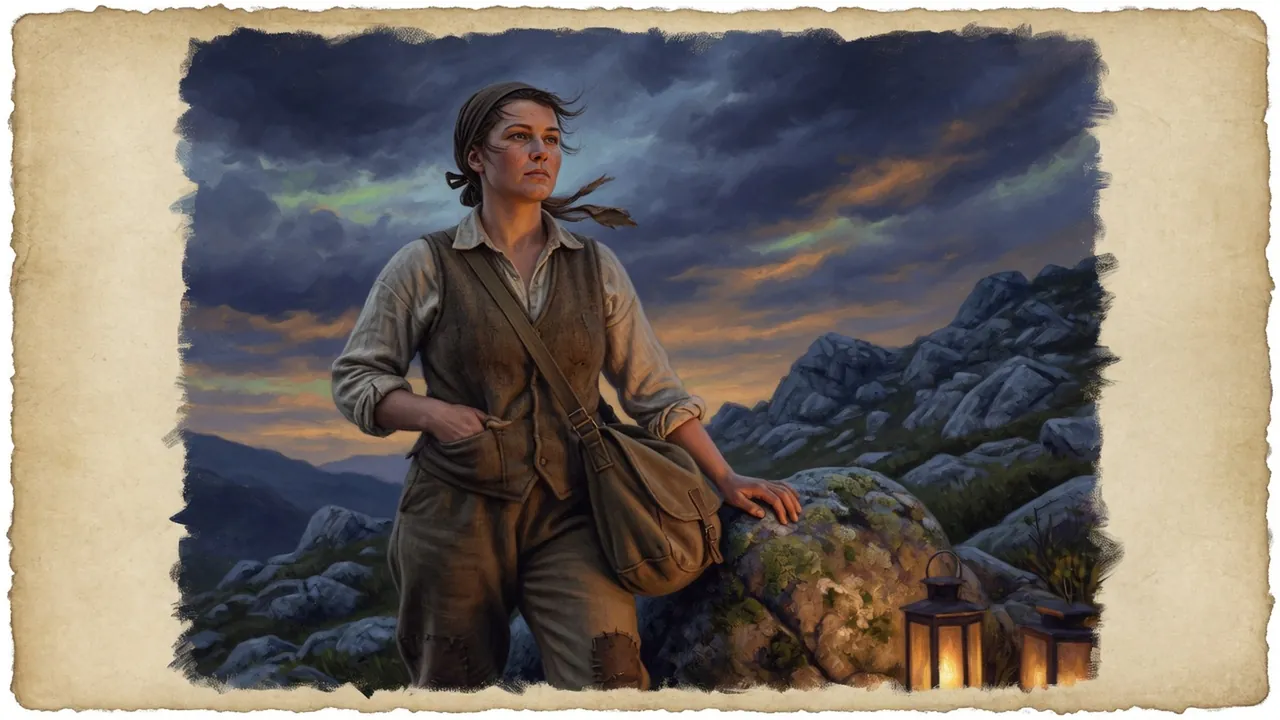
Thousands of plant specimens came home from the first French voyage around the world, gathered on coasts, islands, and mountainsides across the globe. Species after species entered the scientific record under the name of the expedition’s naturalist, Philibert Commerson. The 2012 PhytoKeys paper that named Solanum baretiae notes that more than seventy species were named for him with the epithet commersonii. But on the hardest collecting marches, another person was carrying the plant notebooks, the food, and the weapons, step for step beside him. That person was Jeanne Baret. Legacy in Strokes episode 013 follows how she became the first woman known to sail around the world, and why no plant carried her name for more than two centuries after the voyage.
Commerson’s assistant
Jeanne Baret was born in France in 1740 and died in 1807, at the age of sixty-seven. Before the ships sailed she was already working beside Philibert Commerson, a physician and botanist, as his assistant. His science lived in specimens, notebooks, and long days of searching in the field. Her work lived in the same places: the gathering, the carrying, the pressing, and the sorting of thousands of fragile plants.
A voyage and a disguise
In 1766 France launched its first expedition to sail around the entire world, under the command of Louis-Antoine de Bougainville. Two ships made the voyage together: the frigate La Boudeuse and a heavy supply ship, the Étoile. Commerson joined as the expedition’s official naturalist and was assigned to the Étoile.
There was one serious problem: French naval rules barred women from serving aboard the king’s ships at all. So Jeanne Baret went aboard the Étoile dressed as a man, serving as Commerson’s personal servant. Bougainville’s ship journal, in the Taillemite edition, describes her in one blunt phrase, “valet fille en homme”. Nearly twenty years later, the official file on her pension would describe the voyage in a single plain line: she made it “à la faveur d’un déguisement”, by means of a disguise.
The snows of the Strait of Magellan
Bougainville later wrote, in his published account of the voyage, that Commerson’s servant followed the naturalist on every one of his plant-collecting expeditions ashore. On those punishing marches, he wrote, Baret carried the provisions, the weapons, and the heavy notebooks full of pressed plants, through the snows and across the mountains of the Strait of Magellan.
He called her “infatigable”, tireless, and he called her something far more telling: “botaniste déjà fort exercé”, a botanist already well practiced. He also recorded the nickname Commerson had given her: “bête de somme”, his beast of burden.
Tahiti, as Bougainville wrote it
By the time the ships pushed out into the Pacific, Bougainville wrote, a rumor was running through both of them that Commerson’s beardless servant was in fact a woman. His published account places the moment the rumor became certainty on the island of Tahiti. When Commerson went ashore to collect plants and Baret followed behind him, the islanders surrounded her and recognized her as a woman; an officer on guard duty ashore came to her side and escorted her back to the boat.
Later, aboard the Étoile, Bougainville heard her own account in person and wrote it into his published history of the voyage. A royal decree would later record that “Sa conduite fut très sage et M. de Bougainville en a fait une mention honorable”: her conduct had been very proper, and Bougainville had mentioned her with honor. Other retellings of how she was exposed differ; this page follows only Bougainville’s published account.
Mauritius, marriage, and the long way home
In November 1768 the expedition reached the island of Mauritius, which the French then called the Île de France, in the Indian Ocean east of Madagascar. Commerson and Baret left the voyage there and stayed on the island. The ships sailed on without them, and Bougainville’s expedition arrived back in France in 1769.
In 1773 Philibert Commerson died on Mauritius. On 17 May 1774, at Port-Louis, Jeanne Baret married Jean Dubernat, a former non-commissioned officer of the Royal-Comtois regiment. Afterward she made the long journey home to France. With that homecoming she closed a full circle around the globe, and she is the first woman known to have done it.
The navy’s pension, and botany’s silence
In 1785 the French Ministry of Marine granted Jeanne Baret a pension of two hundred livres a year, counted from 1 January 1785. The file records that she and her husband had reached the age that brings infirmities and could no longer support themselves by their own work. It praises her for having shared Commerson’s labors and dangers with the greatest courage, and in the dry language of a government file it calls her “cette femme extraordinaire”.
The navy that had barred women from its ships was now paying her for that voyage. Botany still had not given her a name.
Baretia, and the plant that finally carried her name
Commerson did know who had been carrying the notebooks. In his private notes (Commerson’s manuscript 887, cited in the 2012 paper) he planned a new genus of plants from Madagascar in her honor and called it Baretia. That name was never published, and the plants he meant it for now sit in another genus, Turraea. For more than two centuries after the voyage, not a single species of plant anywhere carried the name of Commerson’s companion.
In 2012 the botanist Eric Tepe described a new wild relative of the potato from the Andes of southern Ecuador and northern Peru, a region known for exceptional biodiversity. He named it Solanum baretiae, in honor of Jeanne Baret. The authors suggest the choice fits: the plant’s leaves vary dramatically, from a single simple blade to as many as seven leaflets, a quality that echoes the variable-leaved plants Commerson had wanted to call Baretia.
And in 2023 a botanist finally published a genus under the name Commerson had chosen for her. Martín E. Timaná’s paper in Adansonia (45, no. 27) established the genus Baretia, with the Chilean species Baretia lanata, to fulfil the tribute Commerson had intended.
What the record does not establish
Some retellings credit Baret personally with finding the Bougainvillea specimen. The 2012 PhytoKeys paper says the evidence suggests it, but the sources checked for this page do not establish it, so it is not stated here as fact. No source in the record establishes the claim that she met the King or Marie-Antoinette to win her pension; the documented part of that story is Bougainville’s involvement. No exact specimen count is given, because the sources give only approximate figures, and the pension decree is dated only to 1785, because the sources disagree on the day of the month.
Legacy in Strokes. Sources behind this episode: Louis-Antoine de Bougainville, Voyage autour du monde (1771); Bougainville’s ship journal, ed. E. Taillemite, Bougainville et ses compagnons autour du monde 1766–1769 (1977); the 1785 naval pension file, Archives nationales, MAR C7 17, dossier Baré; Société Botanique du Périgord bulletin (2014), including the Port-Louis marriage record of 17 May 1774; Tepe, Ridley and Bohs, “A new species of Solanum named for Jeanne Baret,” PhytoKeys 8: 37–47 (2012); Royal Museums Greenwich, “Meet Jeanne Baret”; Martín E. Timaná, “Honoring Jeanne Baret: Baretia lanata Timaná, comb. nov.,” Adansonia 45(27) (2023).
Watch The First Known Woman to Sail Around the World Got No Credit for Her Plants on YouTube