Tadeusz Kościuszko — also called Thaddeus Kosciuszko in American records — was a Polish-Lithuanian military engineer who arrived in the Revolutionary War as a colonel of engineers. The National Park Service credits him with designing the American defenses at Saratoga, anchored at Bemis Heights (the park spells it Bemus Heights), and with developing the fortifications at West Point in 1778–79. Those are the works Benedict Arnold later tried to hand to the British. Legacy in Strokes episode 012 is about what he tried to do with the American property he left behind.
The will of 5 May 1798
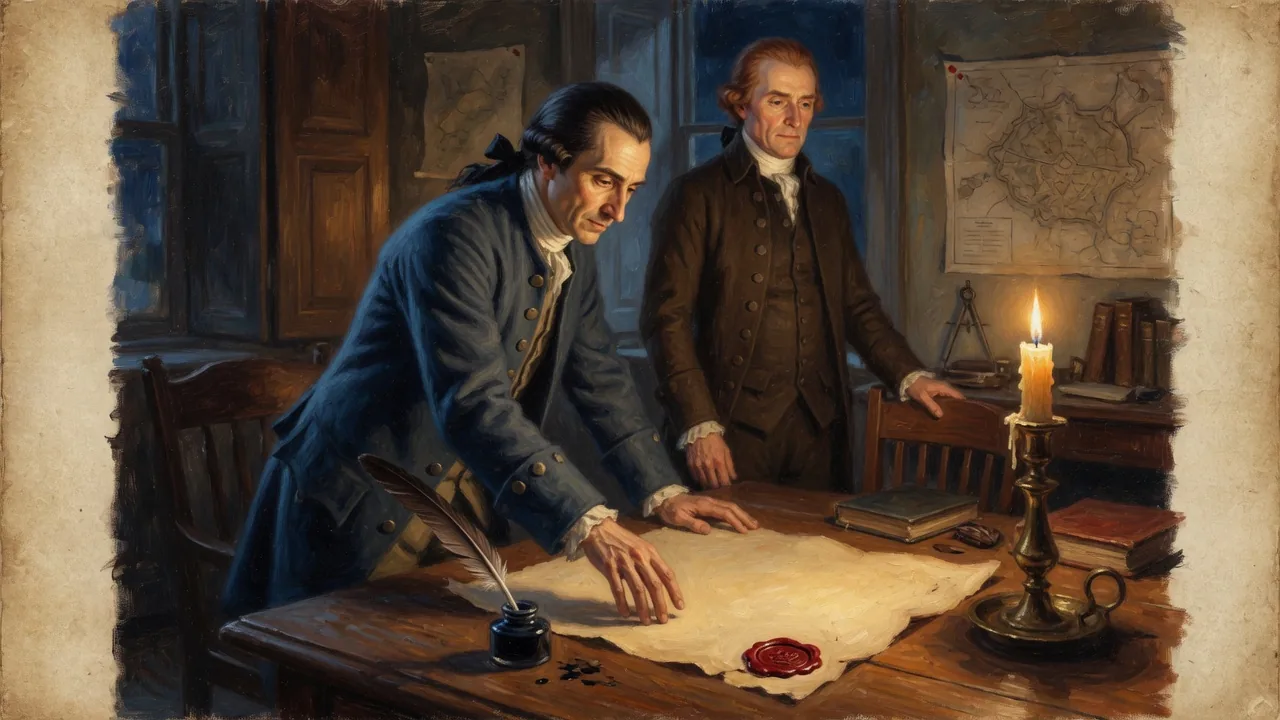
On 5 May 1798, as he was leaving America, Kościuszko wrote a will entirely in his own hand and named his friend Thomas Jefferson executor. The text, preserved by the National Archives on Founders Online, authorizes Jefferson, if Kościuszko made no other disposition of his property in the United States, to employ “the whole thereof in purchasing Negroes from among his own or any others and giving them Liberty in my name.” The same sentence directs that they be educated in trades or otherwise, instructed in the duties of neighbors, parents, spouses, and citizens, and taught to defend their liberty, their country, and the good order of society. The period wording is the will’s. The instruction is emancipation, education, and preparation for citizenship — including people Jefferson himself held in slavery, if Jefferson chose them.
Kościuszko expected that American destination to hold even if he disposed of European property differently. In a 15 September 1817 letter to Jefferson he referred to the funds’ “destination invariable” after his death. The National Archives editorial note quotes that French phrase and reads it as his belief that the American purpose was fixed.
Proved, then refused
Kościuszko died in Switzerland in 1817. He was born in 1746. On 12 May 1819 the Albemarle County Court recorded the will as being in his handwriting. The clerk’s entry, copied on Founders Online, says that “Thomas Jefferson the executor therein named, refused to take upon himself the burthen of the execution of the said Will.”
That is not the same thing as destroying the paper. Jefferson preserved the will and had it proved. He then declined the job. An aging Jefferson hoped John Hartwell Cocke would take the executorship. Cocke declined. Jefferson asked William Wirt for advice, and the will was entered in the Orphans’ Court of the District of Columbia. In 1821 that court appointed Benjamin L. Lear of Washington as administrator. Lear expected Maryland and Virginia law to make the educational clauses hard to carry out, and he planned a school under the African Education Society aimed at educating freed people for colonization in Africa. The National Archives note is blunt about the result: Kościuszko’s American assets were not put to that purpose.
This article does not state a dollar total for the fund. Period summaries disagree once back pay, land, and later bank stock are mixed together, and the episode source notes flag Jefferson-era accounting rather than a single modern figure. The National Park Service does record a separate wartime fact: at the end of the war Kościuszko requested back pay owed him, which the Saratoga park page gives as $12,000. That request is not the 1798 will.
What the Supreme Court did in 1852
Claimants fought for decades over which of Kościuszko’s wills should control the American estate. The National Archives editorial note summarizes the outcome in Ennis v. Smith, decided by the U.S. Supreme Court in 1852: the Court held that language in a will Kościuszko made in 1816 revoked earlier testaments, including the American will of 1798, and his assets in the United States were distributed among his heirs. They were not used to purchase, free, and educate the people the 1798 will named as its purpose.
How clearly Kościuszko understood that a later European will could undo the American plan is a harder question. His 1817 letter still speaks as if the American destination were fixed. The legal result is not hard: the money did not do what the 1798 will ordered.
What this episode will not claim
Jefferson did not tear the will up. He kept it, proved it, and refused to execute it. The American fund was not applied to the emancipation scheme in that will. The engineer of Bemis Heights and West Point left a written order. Courts and executors left it unexecuted.
Legacy in Strokes. Sources actually checked for this page: “Will of Tadeusz Kosciuszko, 5 May 1798,” Founders Online, National Archives; Tadeusz Kosciuszko, Saratoga National Historical Park, National Park Service. The episode package also points to Alex Storozynski, The Peasant Prince, and James S. Pula, Thaddeus Kościuszko: The Purest Son of Liberty; those books were not re-read for this article, so claims that appear only there are left out.
Watch The General Who Tried to Free Thomas Jefferson's Slaves on YouTube